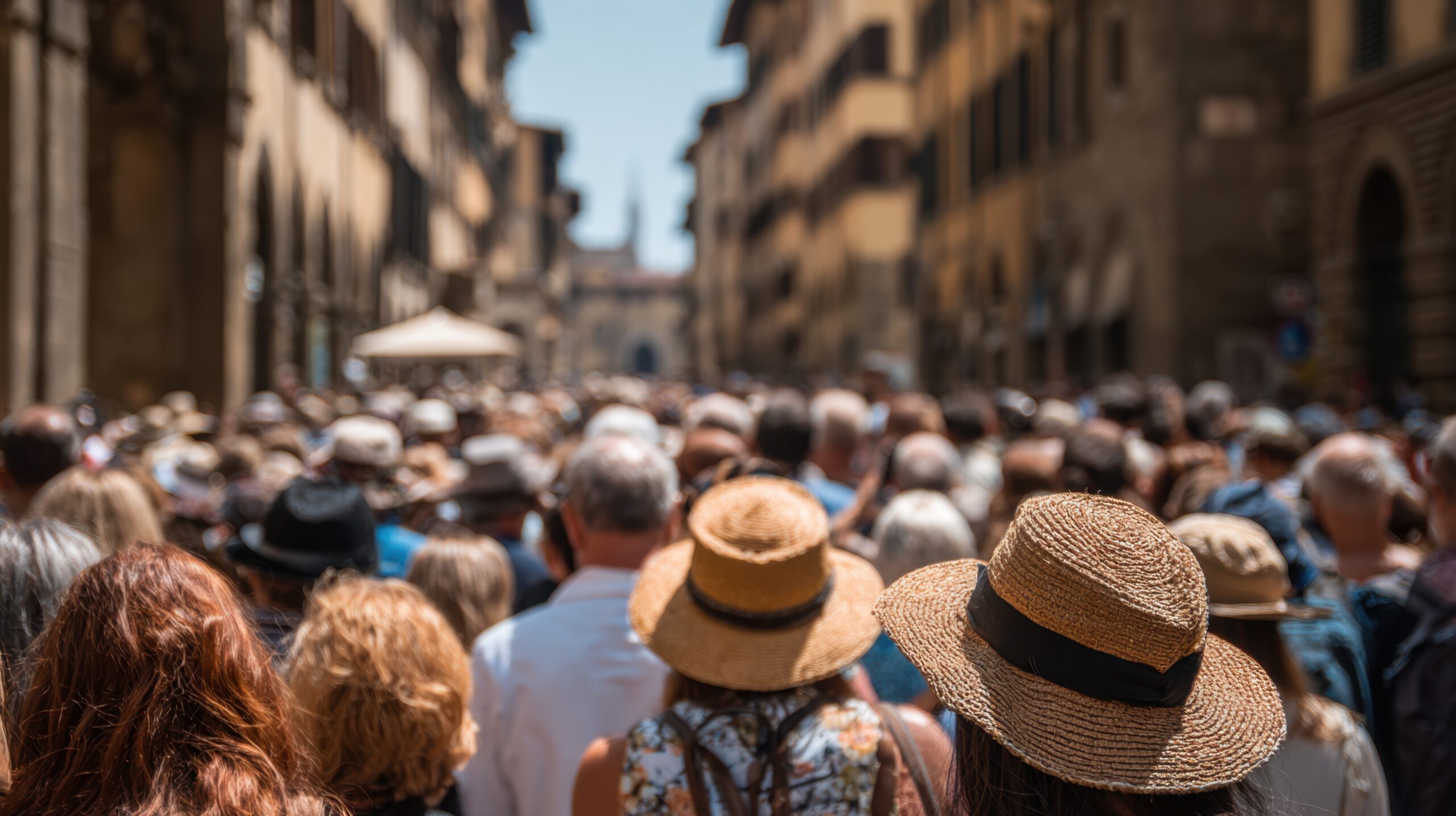
The tourist sees the world, but does not listen to it.
In fact, imagine standing in front of the Trevi Fountain. Around you there are dozens of people: everyone is taking photos, looking for the best angle for a video, and so on, but in reality almost nobody truly knows what they are looking at.
This is the paradox of tourism today: we travel and see more places than ever before, but often we do not understand them.
So the real problem is not only overtourism. The problem is a dysfunctional kind of tourism: concentrated, fast and superficial, where cities become backdrops and the stories of places remain invisible.
That is why Guidexpress was created: a platform that uses GPS and AI to turn every place into a personalised, multilingual and automatic audio story. In short: you walk, and the city tells its story.
Guidexpress aims to rebuild a more conscious relationship between people and the places we visit. Because a historic place should not be limited to being “a photo on Instagram”. It should be able to explain why it exists, which stories it preserves, its historic workshops, the surrounding area, its social fabric, and so on.
These are the things that truly matter in order to understand a new place, and our generation is forgetting them.
In this regard, this morning I found an article written by Isabella Talone, known as @isamuko, on her blog “miciporto”. I found it VERY interesting, and for this reason I want to share it with you here. You can read the original article at this link: full article.
Let us know what you think. Enjoy the read!
Italy is not only at risk of being overwhelmed by overtourism. It is also at risk of no longer being able to tell the story of, and foster respect for, the value of its artistic and cultural heritage.
Italy has the highest number of UNESCO sites in the world: 61 recognised heritage sites, distributed across a relatively small territory that is extraordinarily dense with historical, artistic and landscape layers.
This does not only mean great monuments or famous museums. Italy’s cultural heritage is made up of thousands of churches, palaces, libraries, workshops, historic centres, archives, agricultural landscapes, archaeological sites and places of memory that form a fragile and complex ecosystem.
According to data from the Fondazione Scuola dei beni culturali, in Italy there are more than 4,400 museums, archaeological areas and monuments open to the public. In recent years, cultural tourism in our country has grown enormously. In 2024, Italian state museums alone exceeded 60 million visitors, while almost 44% of foreign tourists choose Italy primarily for its artistic and cultural heritage. These figures show a real interest in our country, but they also reveal a much deeper transformation in our relationship with historic places, and therefore with our cultural heritage.
What kind of relationship are tourists who come to Italy really able to build with the heritage they encounter? Because the relationship between people and cultural places does not arise spontaneously: it is continuously shaped by the way that heritage is narrated, communicated and made accessible.
The visitor is often described as the only person responsible for contemporary superficiality, but that would be too simplistic. Cultural institutions also have an enormous responsibility in shaping how heritage is perceived. For years, and some still do today, many museums, foundations and historic places have communicated art through closed, self-referential or excessively academic languages, incapable of creating a real relationship with the public. Many people do not move away from culture because they are uninterested, but because they feel excluded by a language that seems to speak only to specialists.
This has created a huge communication gap, and social networks have quickly filled it.
Over the last fifteen years, social media have radically changed the relationship between people, travel and culture. Instagram, TikTok and YouTube have become central tools in the construction of the contemporary tourist imagination. According to various international studies, more than 70% of travellers use social media to choose destinations and plan “experiences”, while every day millions of people discover cities, monuments and museums through short, highly visual content.
This change has had important, and partly positive, effects. Social media have made culture more “accessible” and within everyone’s reach, brought new generations closer to art, and given visibility to places that for a long time had remained outside the major tourist narratives. Many professionals in cultural communication have created serious content, able to simplify complex themes without trivialising them.
But alongside this phenomenon, a more problematic transformation has also developed: the idea that having a phone in your hand and a good storytelling ability is enough to produce cultural dissemination. Travel is born less and less from personal research and more and more from a sequence of fast images seen online, images that shape our desire, our expectations and our wish to go to a certain place, city or museum.
The problem, therefore, is not only the uncontrolled growth of tourism. It is the cultural transformation this mechanism is producing: an increasingly less aware and more dysfunctional form of tourism.
For centuries, cultural places were spaces to be crossed slowly. To understand a city, time was needed: one had to walk through it, listen to it, study its history, observe its architectural layers, enter its silences, read books, watch films.
Today, instead, many places are chosen because they are immediately recognisable, photographable and shareable on social media. The logic of the algorithm has progressively replaced the logic of discovery, curiosity and study. It is no coincidence that a global aesthetic of travel now exists: the same terraces, the same views, the same poses, the same sunsets. Everything damnably identical. No individual sensitivity, only one standard narrative that works for everyone. Some scholars openly speak of “social tourism”, a tourism guided by visual reproduction more than by cultural understanding. The result is that many places stop being perceived as complex historical heritage and become scenery for photos.
The algorithm privileges what immediately captures attention. It rewards speed, recognisability and instant emotion. And this inevitably changes the way places are narrated.
Many people arrive in a city with the feeling that they already know it. They have seen hundreds of photographs, reels and videos. They know the iconic views, the panoramic spots, the most shared images. But this visual familiarity is often confused with real knowledge.
Constantly seeing something does not mean having understood it.
The French sociologist and anthropologist Marc Augé had already identified, in the 1990s, a very profound transformation in our relationship with the contemporary world. In his book Non-Places: Introduction to an Anthropology of Supermodernity, he described a society increasingly dominated by speed, excess information and the rapid consumption of spaces.
To explain this change, he used the term “supermodernity”: a historical phase in which everything becomes accelerated, overloaded and continuously available.
According to Augé, one of the most evident effects of this transformation is the loss of a slow and relational connection with places. A city was not only something to see: it was an environment to inhabit, understand and cross over time. Places preserved identities, social relationships, daily rituals and historical layers. Contemporary life, instead, increasingly produces “non-places”: airports, shopping centres, motorways, hotel chains and anonymous spaces designed for rapid transit rather than for creating connection or belonging.
This reflection can now be extended to cultural tourism and social networks. Many historic places are starting to be experienced according to the same logic of rapid consumption. Once, travel implied discovery. Arriving in a city meant confronting something one did not truly know. There was the time of waiting, the time of orienting oneself with a paper map in hand, even the time of getting lost. How beautiful it was to get lost in cities. The place still had the ability to surprise because it had not been completely anticipated by images.
Today, instead, we arrive in places already saturated with images seen and re-seen dozens or hundreds of times. We already know in advance the “photogenic” views, and in fact we go looking only for those: the iconic details, the panoramic points that have gone viral. Travel becomes the visual verification of something we have already consumed digitally.
A study published in the Journal of Consumer Research openly speaks of the “illusion of knowledge”: the more we are exposed to quick and simplified information, the more we tend to overestimate what we think we know.
This is an enormous transformation because it radically changes the very function of cultural travel. Historical heritage progressively loses its complexity and is reduced to an immediately readable experience. A monument becomes “famous” not necessarily because it is historically central, but because it works well within the visual language we have seen on social media. Travel turns into a form of performative consumption: one must see a lot, photograph a lot and constantly produce content proving that one has been in a place.
The consequences are visible everywhere in our art cities. According to data discussed in several studies on cultural tourism, about 70% of international tourists are concentrated in a very small portion of the Italian territory, creating enormous pressure always on the same places. Venice is perhaps the most symbolic example. For years, UNESCO has warned of the risks linked to overtourism and to the fragility of its urban and environmental balance.
But the problem is not only quantitative.
The deeper issue concerns the way heritage is perceived. Because a historic place does not lose value only when it physically deteriorates. It also loses value when it stops being understood in its complexity.
It concerns cultural institutions, which for years have often communicated heritage through languages that were too closed or academic, incapable of creating a real relationship with the public.
It concerns museums, which often fail to speak clearly and passionately to those who enter them.
It also concerns the world of online cultural communication, where authority and visibility are continuously confused. Today anyone with a smartphone can produce cultural content and define themselves as a communicator. Some do so with study, responsibility and competence. Many others, instead, build content based on fragmentary information gathered online, often without any verification of sources or real critical ability. Some do not even provide information, but make beautiful “aesthetic” videos that are pleasant to watch and yet move people to go to that specific place only to reproduce that video.
The problem is not only the historical mistake or the thirty-second format. The problem is the progressive habit of a simplified, fast and immediately consumable culture. A culture that privileges effect over understanding.
And perhaps this is precisely where the greatest risk of our time is hidden: not only overtourism, which I see as a consequence, but cultural habituation.
Because one can become habituated even to beauty. Yes, of course. In fact, perhaps that is exactly what is happening. We are so exposed to images of artworks, monuments and historic cities that we risk no longer truly perceiving their meaning. Continuous repetition produces familiarity, and familiarity often reduces our sense of fragility.
Italian cultural heritage thus risks slowly turning into a permanent background to our contemporary distraction: something always visible, but less and less understood.
And yet a historic city is the fragile result of centuries of history, conflicts, transformations, human labour and cultural transmission. Perhaps today the most urgent question is not how to increase cultural tourism, but how to rebuild a more conscious relationship between people and the places they pass through. The answer cannot be to adapt art cities to the measure of superficial, fast and unaware tourism, turning them into playgrounds where everything can be consumed.
The real challenge should be to create the conditions for heritage to truly speak to people again.
And this means taking on a much broader collective responsibility.
Cultural institutions, for example, already use social networks extensively today. Museums, foundations, archaeological sites and major cultural centres communicate online continuously. The problem, however, is not being present on platforms, but the way they often choose to speak to the public.
On the one hand, there is still communication that is too distant, built through cold, academic or self-referential language, which ends up excluding many people instead of bringing them closer. On the other hand, in the attempt to chase engagement, virality and immediate attention, many cultural organisations risk oversimplifying heritage, adapting it to the codes of fast communication to the point of almost emptying it of depth.
But communicating culture well does not mean trivialising it.
It means making it understandable without impoverishing it.
Cultural communication can be accessible, enjoyable and even engaging without giving up complexity. The problem arises when heritage is reduced only to a spectacular image, a quick curiosity or content designed exclusively to obtain views.
Because a historic place should not be limited to being “Instagrammable”.
It should be able to tell us why it exists, which stories it preserves, what fragilities it carries within it and why all of this still matters in the present.
Social media are extraordinary tools in this direction. They are not only spaces where images are consumed quickly, but places capable of building attention, curiosity and real awareness.
The problem is not the medium. The problem is that we have confused speed with knowledge, and simplification with superficiality.
Because cultural heritage does not survive only thanks to material conservation. It survives when people once again feel it as something that also belongs to their cultural and civic responsibility.
My answer is in the title of this article. Is it a strong statement? Yes. Because in the end, the way a person behaves in front of a historic place says much more than any tourism statistic. It speaks of the relationship we have developed with heritage, with desire, with consumption and even with the very concept of culture.
We have seen this clearly in recent days in Rome, during the traditional shower of petals at the Pantheon for Pentecost, the episode from which this article was born. It is an ancient and deeply symbolic ritual, rooted in religious tradition and in the spiritual relationship between architecture, light and liturgy, which every year attracts thousands of people.
What has been striking in recent years, however, is the behaviour of collective hysteria that has emerged. Hours in line under the sun, a completely congested square, people crowded everywhere, phones raised toward the sky in an attempt to capture the moment, visitors who had come mainly to “see the phenomenon” and reproduce the image already seen online.
Until the climax: moments of great tension and chaos at the entrance, with people pushing elderly people and children without any concern either for other people or for the fragility of the monument. And all of this just to get inside at all costs and take the photo immortalising the fall of the petals.
The Pantheon is not an arena for viral events. It is not a stage set built to satisfy a compulsive need. It is one of the most important monuments in Western history, a space that crosses almost two thousand years of history, religious transformations, architecture and collective memory.
And yet the behaviour of contemporary tourists in front of these places now seems guided by a completely different logic: not to truly live the experience, but to consume it before it ends. To be there before others. To obtain the image. To prove that one was there.
In this way, even an ancient ritual such as Pentecost at the Pantheon risks slowly transforming from a symbolic and spiritual experience into a social-media phenomenon. It no longer really matters what that gesture means, what story it preserves or why it exists. What matters is being there at the moment it happens.
We are building visitors who are increasingly trained to react and increasingly less accustomed to understanding.
People capable of immediately recognising an iconic place, but not necessarily of perceiving its fragility.
People capable of crossing extraordinary cities without developing a real relationship with what they are looking at.
People capable of continuously consuming beauty without feeling any responsibility toward its preservation.
Overtourism is only the visible symptom of something deeper: a progressive cultural ignorance.
Because a society that stops understanding the value of its historic places will inevitably end up treating them like any other consumer product.
And cultural heritage transformed into permanent entertainment slowly risks losing precisely what made it unique: the ability to build memory, awareness and a human relationship with time.